Scientific Symposium
 Learn More
 Learn More

& Synergy
 Learn More


-
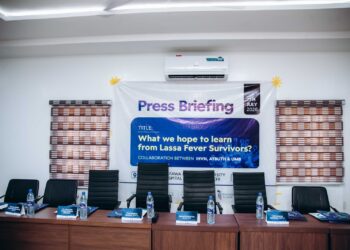
IRCE Announces Launch of Lassa Fever Survivors Research
The Institute of Human Virology Nigeria (IHVN), through its International Research Center of Excellence (IRCE), has announced the launch of a research study to understand how Lassa fever survivors fight and overcome Lassa virus (LASV) infection. The study, titled “Identification and Immunologic Characterization of Adult Lassa Fever Survivors in Nigeria”, is a collaboration between IHVN-IRCE, the Abubakar Tafawa Balewa University Teaching Hospital (ATBUTH) in Bauchi State, and the Center for Vaccine Development and Global Health (CVD) at the University of Maryland School of Medicine. Despite being endemic in West Africa for several decades with high case fatality rates, critical gaps remain in our understanding of how natural infection confers immunity in those that survive Lassa Fever, and how vaccine development can benefit from such knowledge. This 12-month collaborative study will seek to generate deeper insight into natural immunity following infection. The data generated will serve as a critical reference point for ongoing and future Lassa fever vaccine trials. This study will also work with communities to minimize known risk factors and establish a repository of clinical data and biological samples — a valuable long-term scientific resource for the research community. This work will leverage ATBUTH’s and IHVN’s existing world-class laboratory infrastructure. The infrastructure includes its ISO 15189:2022 accredited laboratory in Jos, Plateau State (PLASVIREC), the Institute’s regional biorepository facility (I-HAB) located on the IHVN campus in Abuja and ATBUTH’s molecular diagnostic laboratory- Molecular Genetics and Infectious Disease Research Laboratory. Speaking at the launch, Professor Alash’le Abimiku, the Nigerian Principal Investigator and Executive director of IHVN-IRCE stated: “This study represents an important step forward in our collective efforts to better work with communities to reduce behaviors and exposures that increase the risk of Lassa virus infection. By studying Lassa fever survivors in Nigeria, we are generating locally grounded evidence that will directly inform vaccine development and ultimately save lives.” The research reflects IHVN’s enduring commitment to advancing health through science, strengthening in-country research capacity, and ensuring that African populations are active participants in and beneficiaries of the knowledge generated through research. Prof. Yusuf Bara Jibril, the Chief Medical Officer of ATBUTH highlighted the importance of this study for communities like his in Bauchi that have experienced a surge of Lassa fever cases since November 2026: “Our communities need to be sensitized about Lassa fever and how to protect themselves from getting infected. A Lassa fever vaccine is even more relevant and important now and we as a teaching hospital for the state will continue to partner to make this a reality for our people”. Dr. Suleiman Yusuf, the Lead Collaborator at ATBUTH commented: “Bauchi State has the clinical and laboratory infrastructure to contribute to knowledge that will lead to prevention and treatment of Lassa Fever. In addition, my institution has a long-term relationship with communities to ensure that knowledge on how to prevent Lassa fever transmission is sustained in each community and that health workers recognize clinical symptoms of Lassa for prompt intervention.” “We are excited to collaborate with colleagues in Nigeria and contribute to global efforts to develop effective vaccines against Lassa fever” says Dr. Justin Ortiz, Professor at the University of Maryland School of Medicine Center for Vaccine Development and Global Health in Baltimore, USA, and a Co-investigator of the study. “Studying the natural immune responses of Lassa fever survivors may help identify immune pathways and markers associated with recovery and protection following infection. These findings can provide important scientific context for ongoing efforts to design and evaluate future Lassa fever vaccines” says Matthias J. Schnell, PhD, Director of the Jefferson Center for Vaccines and Pandemic Preparedness at Thomas Jefferson University. Dr. Schnell is the Principal Investigator of the parent NIH contract and the Inventor of a Lassa fever vaccine candidate. Lassa fever remains one of the most significant and persistent public health threats in Nigeria and the rest of West Africa where it is endemic. It is a zoonotic disease caused by the Lassa virus, an Old World arenavirus whose primary host is the rat referred to as Mastomys natalensis. Transmission to humans occurs primarily through contact with food or household items contaminated by rodent urine or feces. The Nigeria Centre for Disease Control (NCDC) has already reported a case fatality rate of 25.1% in the year 2026 with outbreaks across 21 of Nigeria’s 37 states and 85% of cases concentrated in Bauchi, Ondo, Taraba, Benue, and Edo states. There is currently no licensed vaccine for Lassa fever although there are several efforts including that by CEPI to find an effective vaccine against Lassa. Gallery
July 8, 2026 -
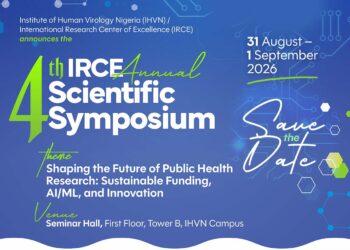
The 4th International Research Center of Excellence (IRCE) Annual Scientific Symposium
The Institute of Human Virology Nigeria (IHVN) has commenced registration for the 4th International Research Center of Excellence (IRCE) Annual Scientific Symposium. Researchers, policy makers, public health experts, health workers and student, within and outside Nigeria are invited to register for the symposium to hold from 31st August to 1st September, 2026 at the IHVN Campus in Abuja. This year, the symposium is themed, “Shaping the Future of Public Health Research, Sustainable Funding, Artificial Intelligence/Machine Learning and Innovation.” Early Bird registration is open until June 30, 2026, and offers a 10% discount. Organizations or groups registering multiple participants can receive an additional 5% group registration discount. The symposium has been held yearly since 2023 with researchers exploring themes such as “Expanding Partnerships to Sickle Cell Disease and Cancer Research,” “Addressing Local Health Challenges through Quality Research and Partnerships” and “Combating Viral Threats Through Public Health Response and Research.” Register now by clicking here
June 26, 2026 -

Global Virus Network awards pandemic preparedness grants to GVN researchers across 4 continents
The Global Virus Network (GVN), for the first time, it is awarding pandemic preparedness research grants, totaling $160,000, to GVN scientists across four continents. These awards support innovative, investigator-led projects designed to enhance viral surveillance, early detection, and scientific preparedness, particularly in regions vulnerable to emerging and re-emerging viral threats. One of the grant recipients is Victoria Etuk ( a research affiliate at IRCE–IHVN), whose project will establish a wastewater-based early-detection system for emerging pathogens in Nigeria – using metagenomics, AI, and geospatial mapping. Read the full press release here: https://tinyurl.com/mw6c8sk7
December 10, 2025

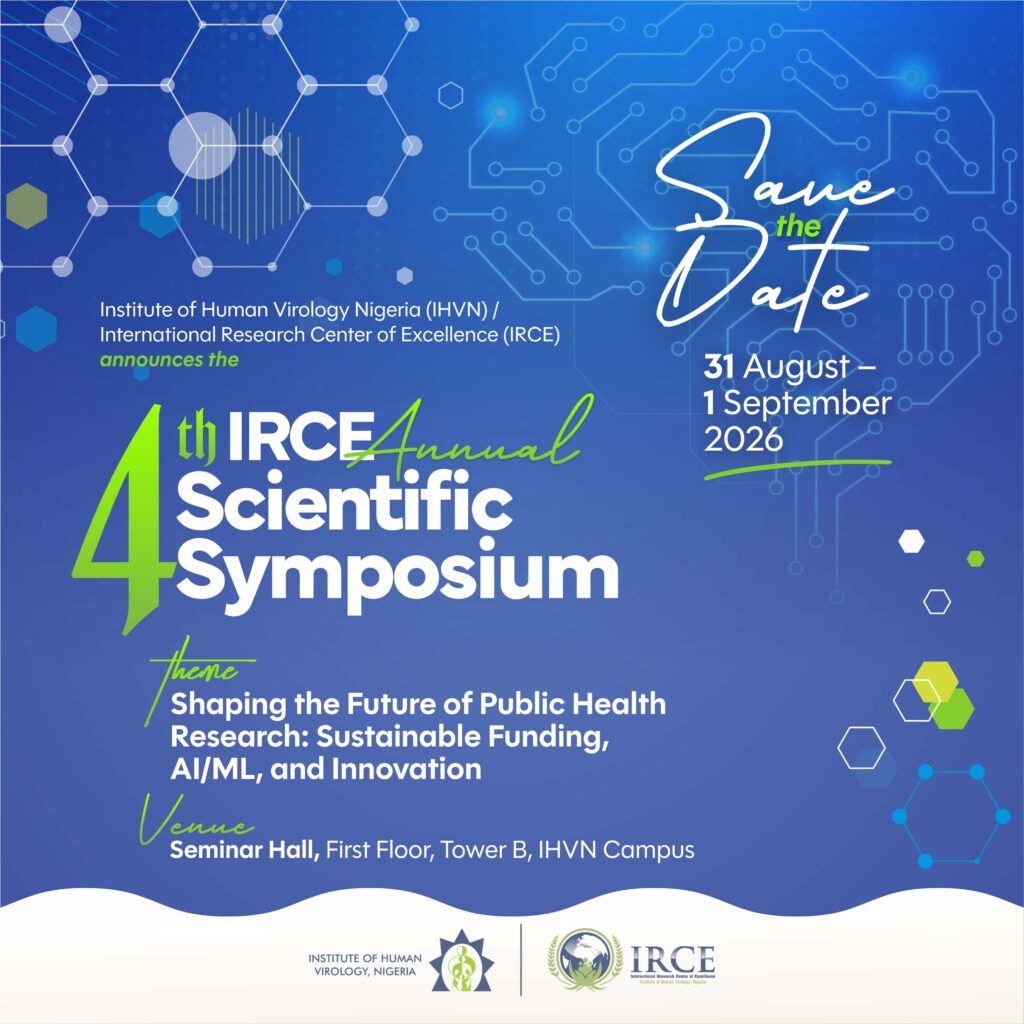
The 4th International Research Center of Excellence (IRCE) Annual Scientific Symposium
The Institute of Human Virology Nigeria (IHVN) has commenced registration for the 4th International Research Center of Excellence (IRCE) Annual Scientific Symposium.
Researchers, policy makers, public health experts, health workers and student, within and outside Nigeria are invited to register for the symposium.
Early Bird Registration Closes: June 30, 2026
Date: 31st August to 1st September, 2026
Location:
IHVN Campus, After Baze University, Abuja, FCT